Edirne Bienali – 'Bridges: Flows' group exhibition, curated by Firat Arapoğlu
Updated: Aug 1
Curator: Firat Arapoglu
Place: Ekmekçizade Ahmet Pasha Caravanserai
Dates: May 21 – June 28, 2026
Open every day except Monday from 10:00 to 17:00.


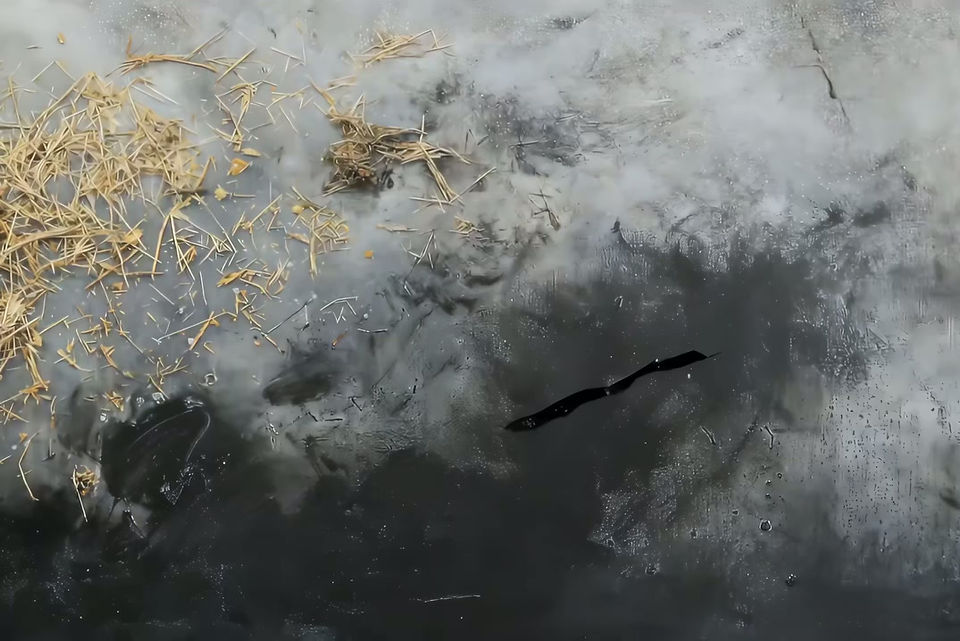
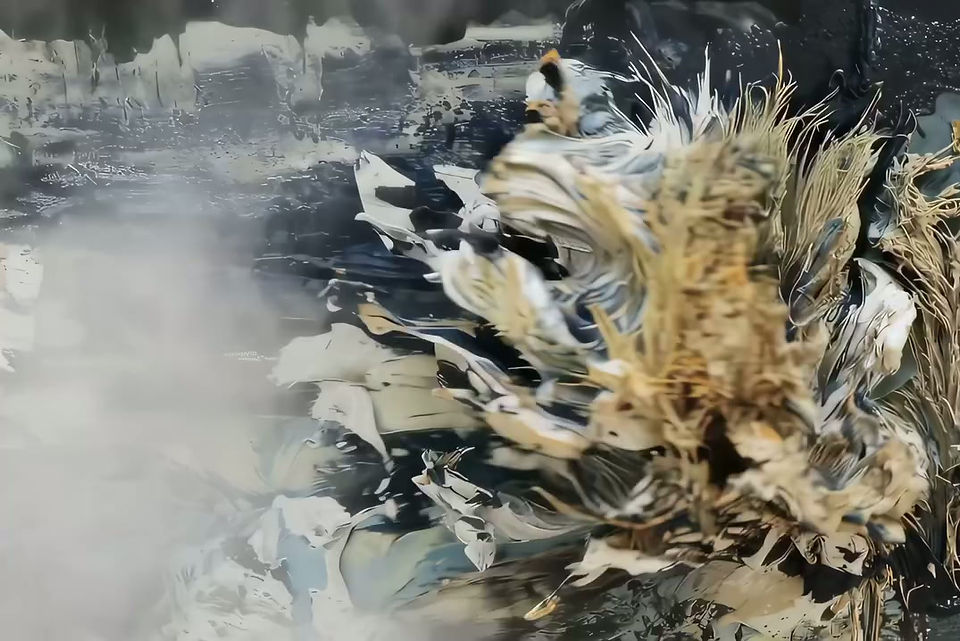


For this group exhibition, Aida Mahmudova presented a 3-channel moving image installation developed directly from a series of heavily layered mixed-media paintings originally created in 2017 for her solo exhibition 'Can’t Capture the Light' at Deweer Gallery in Belgium.
Built from acrylic paint, sand, charcoal, volcanic clay, paper, straw, concrete, epoxy resin, and ink, the original canvases carried an intense physical density and material weight. Through AI, these static surfaces are transformed into moving digital landscapes — where cracks expand, horizons shift, and textures begin to dissolve and flow across three synchronized channels.
The project explores the tension between physical matter and virtual space, allowing the paintings to exist in a new temporal and spatial form.
Swipe to see the transition from the original canvases to the moving image fragments:
— What the Landscape Refused to Forget, 2017
Mixed media on canvas (200 × 300 cm) & AI-generated video (2:00, 2026)
— Where the Light Broke, 2017
Mixed media on canvas (200 × 300 cm) & AI-generated video (2:00, 2026)
— Collapse of the Horizon, 2017
Mixed media on canvas (150 × 250 cm) & AI-generated video (2:00, 2026)
***

Located at the crossroads of Türkiye, Bulgaria, and Greece, Edirne is a city shaped by rivers, borders, and centuries of encounters. Historically a gateway between Anatolia and Europe, Edirne has long served as a crossroads where cultures, languages, religions, and ideological worlds intersect. From its Ottoman past to its role as a geopolitical frontier during the Cold War, Edirne embodies a layered history of transit and population exchange.
The bridges still standing over the Meriç, Tunca, and Arda rivers are not only architectural structures but also enduring symbols of connection, memory, and passage; this makes the city a living archive of encounters between East and West, past and present. The Edirne Biennial allows for the adoption of the bridge both as a central metaphor and as a curatorial methodology.
The bridge, while establishing connection on one hand, also marks distance on the other; it is also a space of movement, uncertainty, and transformation.
In this sense, the biennale approaches art as a threshold practice operating "in between": between cultures, temporalities, identities, and narratives.
Drawing on the archival impulse in contemporary art, the biennale invites artists to engage with history not as a closed past, but as an active and reconstructible space.
The bridges here also evoke rupture and loss; they remind us that the disappearance of connection leaves visible voids, and that memory itself can be fragile, debatable, and in need of reinterpretation.
Bringing together artists from diverse geographies connected by shared rivers, intertwined histories, and intersecting destinies, the Edirne Biennial proposes a transnational space for dialogue.
The exhibition spaces in the city are interconnected through real and symbolic transitions, creating a narrative journey and transforming Edirne into an open-air archive and a space for collective storytelling.
Rather than presenting a single authoritarian narrative, the Biennial creates a platform where numerous voices converge, intersect, and diverge.
Ultimately, the biennale sees itself as a living bridge: connecting local and regional histories, personal memory and collective experience, echoes of the past with the possibilities of future transitions.
Curatorial text
Located at the intersection of Turkey, Bulgaria, and Greece, Edirne is a city shaped by rivers, borders, and centuries of encounter. Historically a gateway between Anatolia and Europe, it has long functioned as a threshold where cultures, languages, religions, and political imaginaries intersect.
From its Ottoman past to its Cold War role as a geopolitical frontier, Edirne embodies layered histories of passage and exchange. Its bridges still standing over the Meriç, Tunca, and Arda rivers are not only architectural structures but enduring symbols of connection, memory, and transition, rendering the city itself a living archive of encounters between East and West, past and present.
The Edirne Biennial adopts the bridge as both a central metaphor and a curatorial methodology.
A bridge connects while simultaneously marking distance; it is a space of movement, uncertainty, and transformation. In this sense, the biennial approaches art as a threshold practice one that operates "in between": between cultures, temporalities, identities, and narratives. Drawing on an archival impulse in contemporary art, the biennial invites artists to engage with history not as a closed past but as an active, reconfigurable field. Bridges here also evoke rupture and loss, reminding us that the destruction of connection leaves visible voids, and that memory itself can be fragile, contested, and in need of rearticulation.
Bringing together artists from diverse geographies connected by shared rivers, intertwined histories, and overlapping destinies, the Edirne Biennial proposes a transnational space for dialogue. Exhibition venues across the city connected by literal and symbolic crossings form a narrative journey, turning Edirne into an open-air archive and a site of collective storytelling. Rather than offering a single authoritative narrative, the biennial creates a platform where multiple voices converge, intersect, and diverge. Ultimately, the biennial envisions itself as a living bridge: connecting local and regional histories, personal memory and collective experience, and the resonances of the past with the possibilities of future crossings.


Comments